Author: Christopher Alexander
First Published: 1979
Genre: non-fiction, architecture
First Published: 1979
Genre: non-fiction, architecture
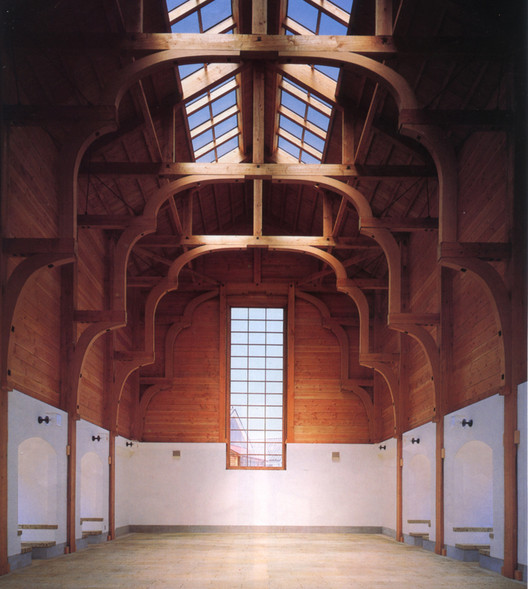
Modernity’s Fork: Society is too complex to rationally plan, yet too fragmented to simplify through consensus.
How do we resolve Modernity's Fork? One solution is to insist that society can be rationally planned, the strategy of communists and techno-optimists. Another is to insist on a deep consensus and harmony underneath reality which reduces complexity; complexity, on this view, is not the design of God but man. Christopher Alexander is extremely unusual in that he has tried both.
His first attempt was Notes on the Synthesis of Form in 1964. He proposed a rigorous, rationally defensible, mathematical model of good building design. Followers of Alexander who prefer his early phase continue to search for a mathematical definition of beauty or communal harmony. 15 years later, Alexander had abandoned this solution:
What I found in my voyage were the early parts of a chain of thought that started with cybernetics, mathematics, and a plain-spoken computer; passed through “A City is Not a Tree”; paused to “make God appear in the middle of a field”; and ended with this fundamental design goal: I try to make the volume of the building so that it carries in it all feeling. To reach this feeling, I try to make the building so that it carries my eternal sadness. It comes, as nearly as I can in a building, to the point of tears.
Extract from: Notes on “Notes on the Synthesis of Form”, Richard P. Gabriel (2023).
The traditional objection to this solution is that it is undemocratic. "The Quality Without a Name" is only open to those who can appreciate or experience it. Christopher Alexander's reply is that it is radically democratic, for the same quality of goodness is within us all:
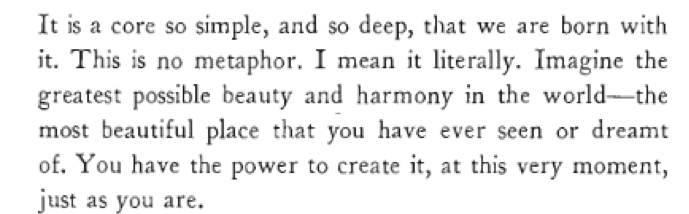
Our apparent fragmentation is only temporary. It is a tragic state of affairs (either a wrong turn or fall from heaven) produced by a sick modernism. Yet all who enter a timeless building will see, or can see, the quality without a name.
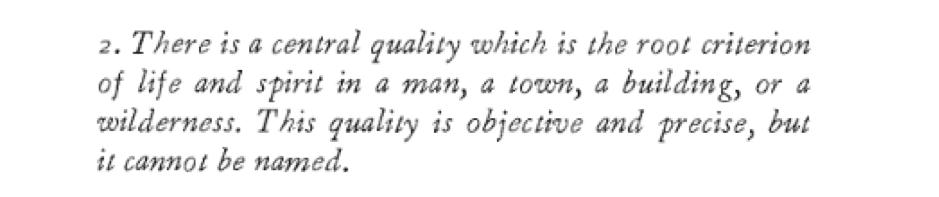
Christopher Alexander’s argument is spiritual: he believes in a version of non-dualistic panpsychism in which everything possesses the spiritual “quality without a name.” It is there when you feel most yourself; it is there in the calm of the brook; in the setting of the sun and the whistle of the wind.
Alexander is not alone in recommending this as a solution to modernity. He is joined by many other Romantic Liberals who favour his world of acoustic, natural small-scale living. Alexander's model of the 'good life' has been described as “comfortable, easygoing, sensuously pleasurable, communal, and full of leisure time for socializing and solitude.” Based on his buildings, this is indeed what he wants: natural materials; space for quiet reflection, relaxation, thought, and appreciation of beauty; communal life; love; heartbreak; games; and quiet. Here is his life:
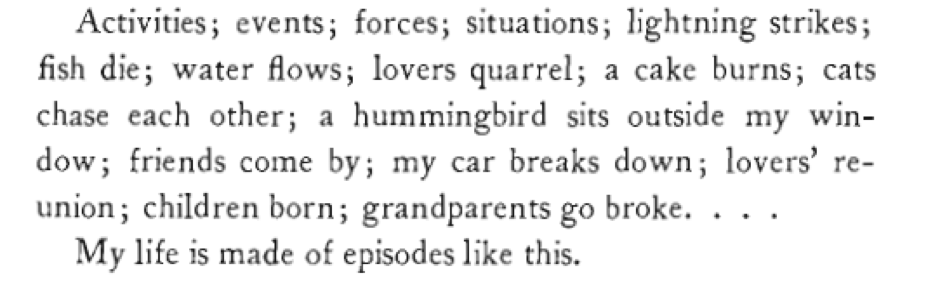
And his favourite moments:
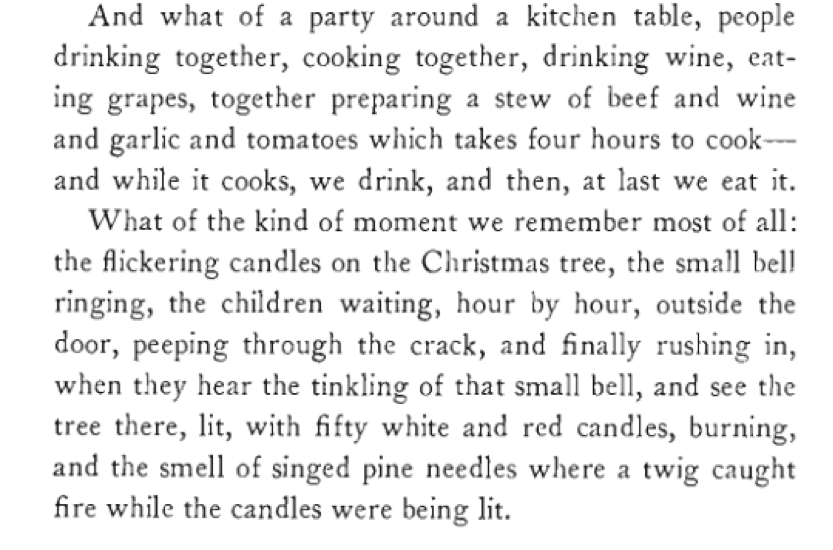
So yes, Alexander is a believer in the (domesticated) Romantic Liberal life. He is a humanist, a friend of humanity and enemy of the artificiality of modernity. He longs for a life, above all, freed of fear, of control, of strictures.
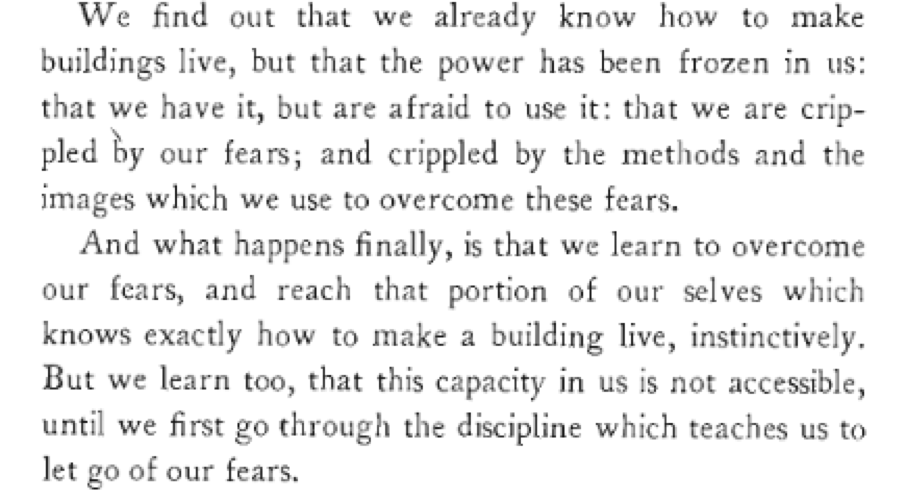
It is a highly liberal model, one premised on the belief that we should be allowed to act freely, for in each of us is endless wonderful possibility. It is perfect for an individualistic-spiritualistic model of life: that you just need to be yourself, and you will produce beauty:
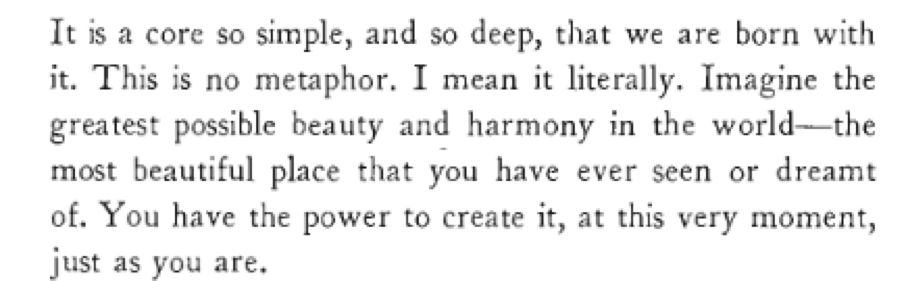
What, exactly, does it feel like to “live”? Alexander is not particularly clear here. He believes people in the past lived intuitively according to the quality without a name (hence why their buildings were invariably more beautiful). Thus, it cannot be euphoric: people in the past did not live invariably exciting, dynamic lives. Nor is it straightforwardly about living in the moment. In general, their lives were often miserable, difficult, and painful. I think a fair reconstruction of living by the quality without a name looks goes as follows:
You are often uncertain and in pain. But you are not uncertain about who you are. Nor are you ever bored in the sense we would recognise. You are much closer to being a plant or animal than a modern person.
Your life is highly vivid because you take more of what you see as a given. You can be brought to tears and genuine laughter more easily than we can today. You are more like a child.
In your community, there is the complete range of human experience. There are lazy people, angry people, the ambitious, the caring, the old, young, frail, strong, beautiful, and the ugly.
He seems to adopt an extremely Romantic view of the liberated individual. When you give up all forms of control, stricture, limitation; all possessions, all worries, all fear of ridicule, you reveal this quality:
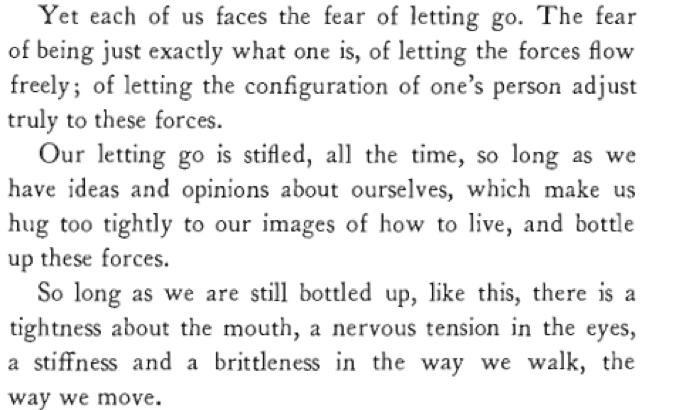
It is a life of “no ties”, “no suits”, “no anxiety”: “only the laughter and the rain.” It is the intense vividness and clarity of purpose which, for example, the protagonist of Ikiru experiences when he finds out he is going to die. And yet… how many people, either now or in the past, have ever lived like this? Could live like this? It seem to be the exact dilemma of My Dinner With Andre of the extraordinary meeting the ordinary.
As with all specific pictures of living well, the danger is in the details. There are three controversial aspects in The Timeless Way of Building. First, there appears to be a clear limit on how big society can get whilst retaining the “quality without a name”:
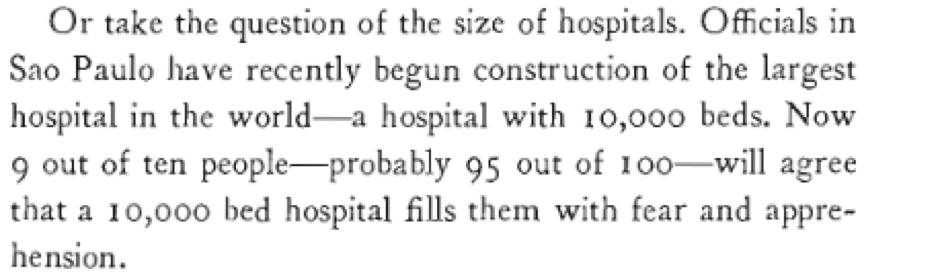
I have no idea what he made of post-1960s civilisation: how did he think we could live at a local level given current population densities? His relationship with modern technology was similarly difficult. He is probably best regarded as having a kind of secular-Amish view of technology. He accepted the car, the telephone, the computer, and the aeroplane. He likely would have accepted the early internet of the 90s, and possibly the dumb mobile-phone. He almost certainly would have opposed soical media, the modern internet, the motorway, mass air travel, and many more of our modern innovations. How do we work out where this sweet spot is…?
To some degree, then, you fear that he implicitly resigned himself to the same fate as the organisers of the Newport Folk Festival: as one subculture, theoretically the true way of living but practically no better or worse, amongst all the rest. The problems of collective slow living seem just that insurmountable.
Second, he is clearly at least reasonably socially conservative. That is, he appears to believe in general differences between men and women:
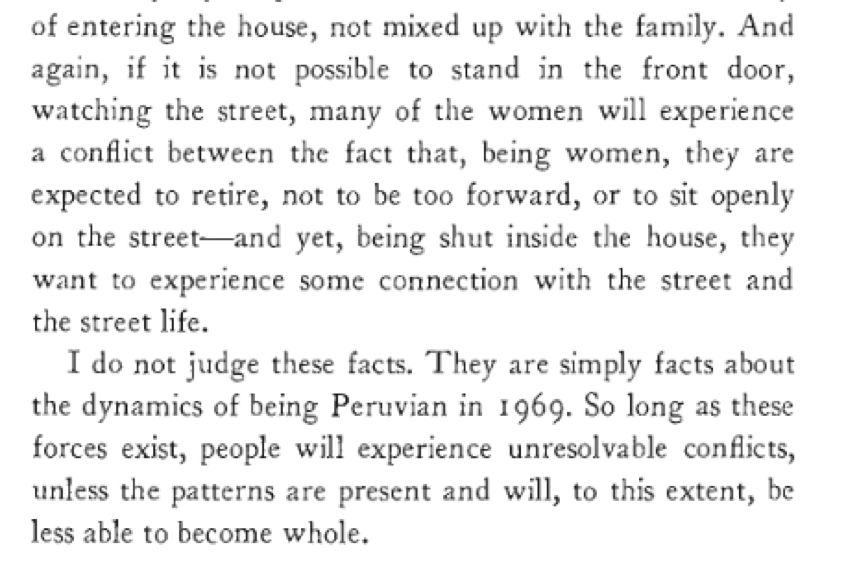
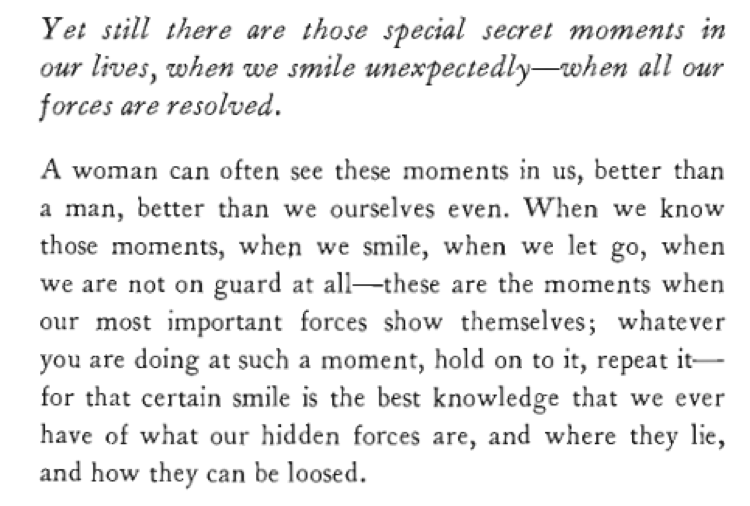
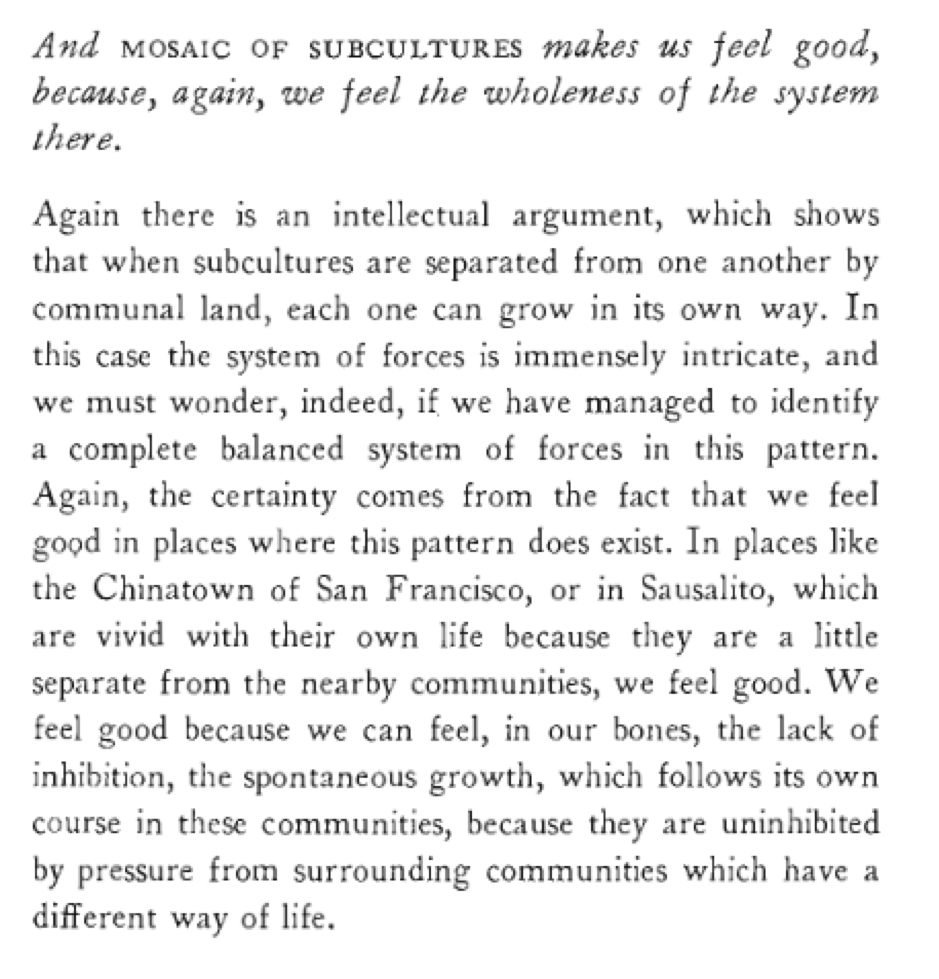
Alexander appears to also believe these differences, actualised at a local level, need to be taken as a fixed part of the design “context”:
The real crux of the matter lies in how much flexibility there is in the quality without a name . The way I read him, Alexander believes that within us all is the spark of “life” – that is, the quality without a name. This quality can be suppressed and hidden by modernism but is always lurking beneath (c.f. the ‘inner child’).
So far so good. This makes sense for responses to essentially natural design problems: e.g., where to get water, how to produce food, producing shelter. It is also fairly compelling for semi-natural problems, such as caring for the elderly, providing space for raising the young, and communal spaces for living. But here we immediately ask: can ‘life’ produce a living solution to all problems, even those produced by ‘dead’ processes? Is there a ‘living’ way of making an advert for car insurance?
He seems committed, in a manner now regarded by most on the left as uncomfortable, to the idea of distinct, historico-cultural communities:
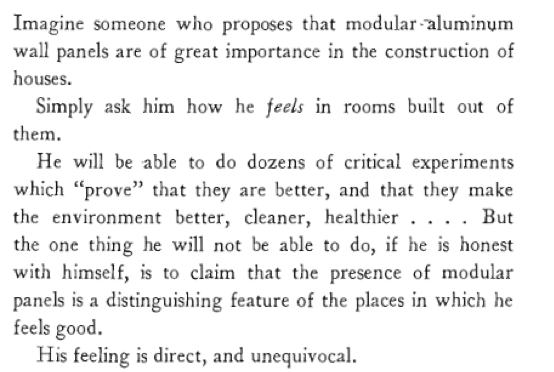
This is related to his idea of the “pattern gene-pool” which are all the patterns percolating, inherited (via person-person traditions), in a community. Naturally, if we emphasise feeling, experience, and tradition, we are naturally going to become more conservative regarding our communities. This is good because it also increases the variety of life: a “natural differentiation will occur, in which each town, each region, each culture, adopts a different set of patterns – so the great stock of pattern languages across the earth will gradually get differentiated.” (346). It is unclear whether he thinks there are national patterns, or, for that matter, global patterns (even if he thinks, at the local level, there are many parallels between countries).
To summarise, Alexander remains pluralistic regarding different subcultures. This is because the design problems thrown up by human life and our current technology offer multiple living solutions: a culture which suppresses gay people, or one which imprisons women in suburban hell is not a living culture. But there are often several living cultures for a given environment (which includes, maybe, genes, existing buildings, the natural environment, the legacy of childhoods). But who is to say if, given a particular culture, there is “life?” And how much life?
Again, Alexander would respond that we all immediately know, when entering a culture, if it is alive. The people fall in love, they feel things, they build things, they produce more life, they building their own style of living buildings, they have parties, they appreciate nature.
The most terrible monsters lurk in the shadows waiting to tear this vision apart. How can Alexander's vision handle the scale of mass industrial society? How can it reconcile global inequalities and the great variability in cultures, some fitting the new Modern Way, others falling behind? What do we make of those who reject his dreams? The crooked, the fucked up, the alienated? Alexander was flabergasted by architects like Eisenmann who were explictly anti-human. Eisenmann made public buildings deliberately to be uncomfortable (even spreading a rumour one of his galleries made people queasy). When challenged, he protested:
…For you to determine arbitrarily that I am screwing up the world seems self-righteous and arrogant.
If only these issues could be resolved pre-culturally by reference to a universal spiritual truth. Can't Eisenmann see what he is doing is harmful and wrong? Can't he see that he is fucking up the world? yet the moment we seem to contextualise the good life in culture - in concrete recommendations - the monsters start gnashing their teeth. Progress! Eugenics! Dysfunction! The Ensouled and Souless! Enlightened Empire! It is unsurprising Alexander remains a fringe figure outside of web-design: he is too liberal to be a true conservative, and too conservative to be a true liberal. He thus falls into the same humanistic gap that other men of brave integrity fall, joining company with the likes of Abraham Lincoln, Charles Ramsay, Christopher Lasch, and Charles Dickens:
When one reads any strongly individual piece of writing, one has the impression of seeing a face somewhere behind the page. It is not necessarily the actual face of the writer... What one sees is the face that the writer ought to have. Well, in the case of Dickens I see a face that is not quite the face of Dickens's photographs, though it resembles it. It is the face of a man of about forty, with a small beard and a high colour. He is laughing, with a touch of anger in his laughter, but no triumph, no malignity. It is the face of a man who is always fighting against something, but who fights in the open and is not frightened, the face of a man who is generously angry — in other words, of a nineteenth-century liberal, a free intelligence, a type hated with equal hatred by all the smelly little orthodoxies which are now contending for our souls.
Extract from: “Charles Dickens”, George Orwell (1940).
There is a much longer version of this review here